Solar eclipse cruise/tour
The East Kimberley is the best place to view the solar eclipse!
On 22 July 2028 a rare total solar eclipse will traverse Australia. Western Australia’s east Kimberley region is the best viewing destination in the world. This event marks the second of five total solar eclipses visible from Australia between 2023 and 2038.
The eclipse’s path of totality will first make landfall in the Kimberley with towns such as Wyndham and Kununurra positioned directly in its path. On the Gibb River Road and further north up Kalumbaru Road, prime viewing locations include El Questro and The Mitchell Plateau. Along the Kimberley coast, one of the best locations will be Bigge Island.
The Kimberley is renowned for its clear skies and minimal light pollution, providing optimal conditions for eclipse observation.
The rugged landscapes, including ancient rock formations and expansive wilderness areas will serve as a dramatic backdrop during the eclipse’s totality. The maximum duration of totality will occur in the east Kimberley, lasting approx: 5 minutes and 10 seconds; the longest duration of totality anywhere in the world!
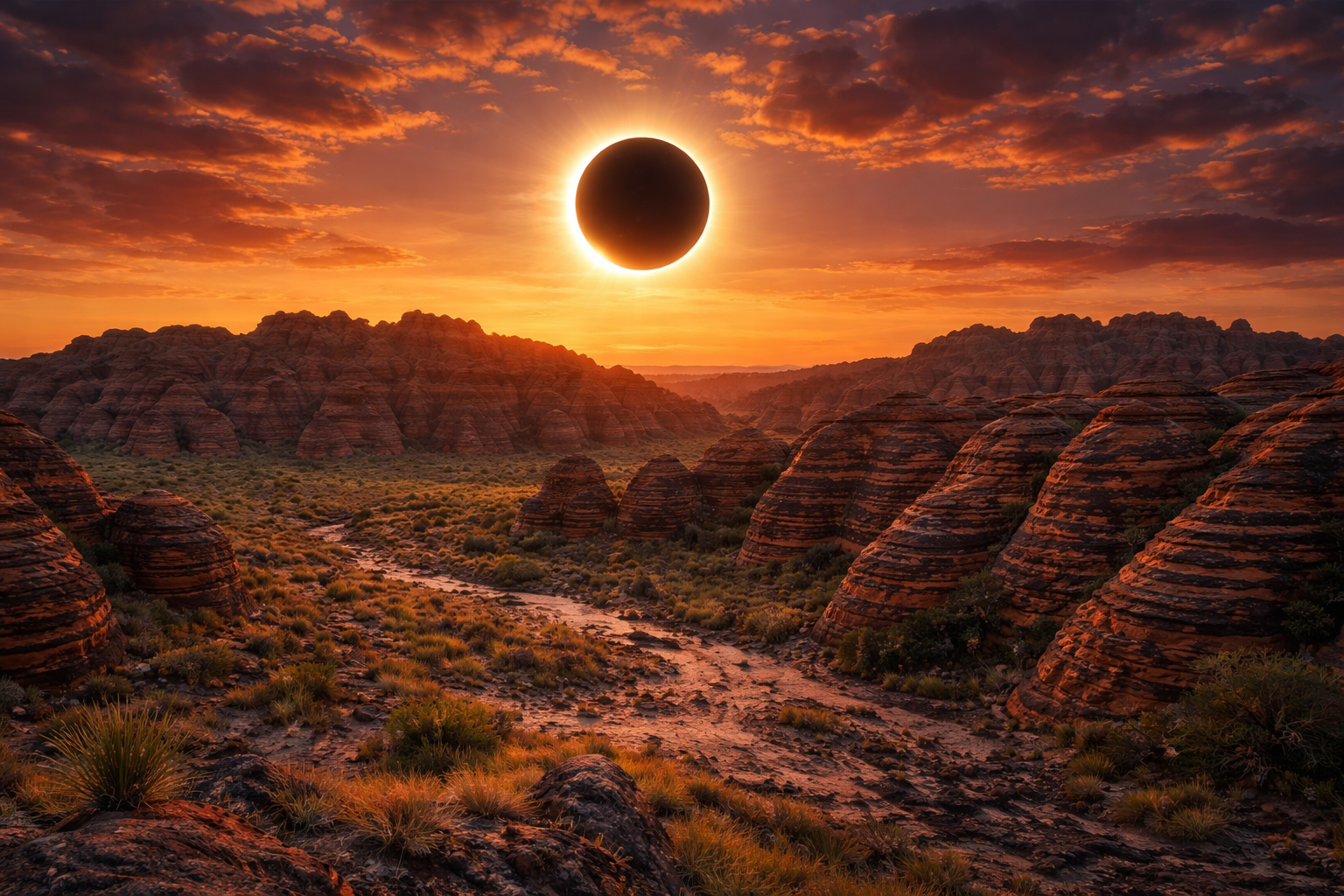
The World Heritage Listed Bungle Bungles (Purnululu) National Park will be one of the world’s most scenic places to view the eclipse! Note - image is an A.I render.
Our exclusive solar eclipse touring package
We are currently putting together an week eclipse package, which will include:
3-4 nights in the East Kimberley
4×4 tour (in our vehicles) to the best eclipse viewing location on 22 July
2 days of East Kimberley touring – Old River, Bungles, Lake Argyle
10 night Kimberley coastal cruise
Contact us if you would like to be added to the waitlist, so we can email you once our package is released!
What is a total solar eclipse?
A solar eclipse is a celestial event that occurs when the Moon passes directly between the Earth and the Sun, casting its shadow upon the Earth’s surface. This alignment, known as “syzygy,” results in the Sun being obscured, either partially or completely, depending on the observer’s location. The Moon’s shadow consists of two parts: the umbra, the darkest central region, and the penumbra, the lighter outer region. Observers within the umbra experience a total solar eclipse, while those in the penumbra witness a partial eclipse.
Solar eclipses can be classified into three main types:
Total Solar Eclipse: Occurs when the Moon completely covers the Sun, revealing the Sun’s corona—the outer atmosphere that is usually obscured by the Sun’s bright light.
Partial Solar Eclipse: Happens when only a portion of the Sun is obscured by the Moon, leaving a crescent-shaped sliver of the Sun visible.
Annular Solar Eclipse: Takes place when the Moon is farther from Earth in its elliptical orbit, appearing smaller in the sky and not fully covering the Sun. This results in a ring-like appearance known as the “ring of fire”.
The 2028 total solar eclipse is particularly noteworthy because it will be visible from a relatively narrow path on Earth. The path of totality—the area where the total eclipse can be observed—will cross parts of Western Australia, including the Kimberley region.
This Kimberley Solar Eclipse 2028 blog first appeared on the Kimberley Cruise Centre website
